You want a hand push seeder guide that helps you get the best results for your farm. The right tool will match your crops, soil, and budget. You need something easy to push in a straight line and simple to fill or empty. When you use a hand push seeder guide, you gain precise seed placement and accurate depth adjustments. You can see the seed level and seed drop, which helps you avoid mistakes. The hand push seeder guide also gives you flexibility for different seed types and soils. You save money because you balance cost with what your field needs. Use this hand push seeder guide to find dependable row markers and models that require little upkeep.
Key Takeaways
What Is a Hand Push Seeder?
How Hand Push Seeders Work
You use a hand push seeder to plant seeds quickly and evenly. This tool helps you with small farming tasks by making seed placement simple. You fill the hopper with seeds, set the row spacing, and push the seeder along your field. The drive train, which includes a cleated ground wheel and steel axle, powers the seed plate hub. As you move, the metering mechanism picks up each seed and drops it into the soil at the right spot. You can adjust the depth and spacing to fit your crop needs. This process gives you more control over your planting.
Tip: Always check the seed plate for the right size and shape. This step ensures you get the full benefits of precision seeders for your small farming operation.
Here is a quick look at the main parts and how they work:
Component/Mechanism | Description |
Drive Train | Cleated ground wheel and steel axle drive the seed plate hub. |
Metering Mechanism | Rotating plate with cells picks up and releases seeds into the drop tube. |
Workflow | Fill hopper, set spacing, push seeder, and release one seed per rotation. |
Hand push seeders differ from jab planters. You push the seeder along the ground, while jab planters need you to insert seeds by hand. You can adjust seed spacing from 1 to 20 inches. Both tools let you control depth, but hand push seeders make the job faster and easier for small farming plots.
Benefits for Small Farms
You see many benefits of precision seeders when you use them on small farms. You can work standing upright, which reduces fatigue. You finish planting faster and with more accuracy. This tool helps you use less seed and fertilizer, which saves money and resources. You also improve your crop yield because seeds and fertilizer go exactly where you want them.
Here is a table showing the main benefits for small farming:
Description | Benefit Type |
Stand upright to reduce fatigue | Labor efficiency |
Plant faster and more accurately | Labor efficiency |
Place fertilizer accurately for better yields | Crop yield improvement |
Use less seed for better resource use | Resource use efficiency |
Simple design fits the needs of small farms | Accessibility |
Improves your livelihood through better yields | Livelihood improvement |
You get the benefits of precision seeders because these tools come from ideas shared by local farmers. The simple design uses local materials, so you can fix or replace parts easily. You make your small farming operation more resilient and productive with the right hand push seeder.
Hand Push Seeder Guide: Key Factors to Consider
Seed Type and Compatibility
You need to pick a manual seeder that fits your seeds. Crops have different sizes and shapes. Some seeds are tiny and round. Others are big or flat. Using the wrong manual seeder can cause bad seed spreading. Rows may look uneven. Precision seeders help you plant seeds at the right depth. They also help with spacing. This makes your crop grow better and cuts down waste.
Here is a table showing common seed types and which manual seeder models support them:
Seeder Model | Supported Seed Types |
Seeder A | Carrots, Beets, Radishes |
Seeder B | Lettuce, Spinach, Kale |
Seeder C | Peas, Beans, Corn |
Seeder D | Tomatoes, Peppers |
Seeder E | Radishes, Carrots |
Seeder F | Flower Seeds |
Seeder G | Herbs, Green Onions |
Seeder H | Pumpkins, Squash |
Seeder I | Mixed Vegetables |
Seeder J | Zucchini, Cucumbers |
Check if your manual seeder works with your seeds before planting. Precision seeders give each seed the right space and depth. This helps seeds sprout and gives you more crops. If you use a regular manual seeder, you might waste seeds. Your plants may not grow evenly.
Aspect | Traditional Seeder | Precision Seeder |
Seed placement | Random or loosely spaced | Exact spacing and depth per seed |
Seed waste | Higher, overseeding common | Lower; single-seed metering |
Yield impact | Baseline | Up to 15% improvement in optimal conditions |
Tip: Try your manual seeder with a small batch of seeds first. This helps you spot mistakes. It also helps you make straight and even rows.
Soil Preparation and Field Conditions
You must get your soil ready before using a manual seeder. Good soil makes seeding work better. Follow these steps for the best soil:
Take out rocks, sticks, and big clumps of dirt.
Loosen the soil so air can get in.
Make sure the soil is damp but not too wet.
Good soil helps your manual seeder roll smoothly. It drops seeds at the right depth. Different crops need different depths and spaces. Adjust your manual seeder for each crop. Even spacing helps plants get enough food and grow strong.
Getting soil ready is important for planting. It affects where seeds go and how well they sprout.
Crops need certain depths and spaces to grow their best.
Even spacing stops plants from fighting for food and helps them grow.
If your field has raised beds or bumpy ground, pick a manual seeder that works well there. Precision seeders often handle uneven ground better than regular ones.
Seeder Capacity and Field Size
Match your manual seeder’s size to your field. Small plots need light manual seeders. Big fields need seeders with bigger hoppers and faster planting. Seeder capacity changes how fast you finish seeding.
Planting Speed (mph) | Increase in Capacity (%) | Acres per Hour |
7 | 30 | 6 |
8 | 40 | 28 |
A bigger manual seeder lets you plant more rows quickly. This saves you time and helps you finish before weather changes. If you want to plant lots of rows, pick a manual seeder with adjustable row spacing and a large hopper.
Note: For direct seeding, check the hopper size and how many rows your manual seeder can plant at once.
Precision Seeders vs. Standard Models
You need to choose between a standard manual seeder and a precision seeder. Precision seeders put seeds in the right spot and space. This cuts down on wasted seeds and gives you more crops. Standard models are good for basic planting but may not be as accurate.
Feature | Mini Corn Seeder | Standard Corn Seeder |
Precision Planting | High precision for small plots and specialty seeds | High consistency for row crops over large fields |
Coverage Area | Up to 2 hectares | 2 hectares to hundreds of hectares |
Ease of Use | Manual operation; lightweight and portable | Mechanized; tractor required |
Cost | Lower upfront, higher labor costs | Higher upfront, lower labor per hectare |
Maintenance | Simple; occasional part replacement | Complex; regular checkup and calibrations |
Adaptability to Terrain | High—suited to raised beds & undulating ground | Medium—best for uniform, well-prepared fields |
Precision seeders use single-seed metering. This means one seed goes in each spot. It helps with direct seeding and cuts waste. Standard manual seeders may drop too many seeds or miss spots. Precision seeders can boost your crop yield by up to 15% if conditions are good.
Feature | Traditional Seeder | Precision Seeder |
Seed placement | Random or loosely spaced | Exact spacing and depth per seed |
Seed waste | Higher, overseeding common | Lower; single-seed metering |
Yield impact | Baseline | Up to 15% improvement in optimal conditions |
If you want to plant special crops or use raised beds, pick a precision seeder. For big, flat fields, a standard manual seeder may be fine.
Durability and Cost
Think about durability and cost when picking a manual seeder. A strong manual seeder lasts longer and needs fewer fixes. Look for models with tough frames and parts that are easy to change. Precision seeders cost more but give better results and save seeds.
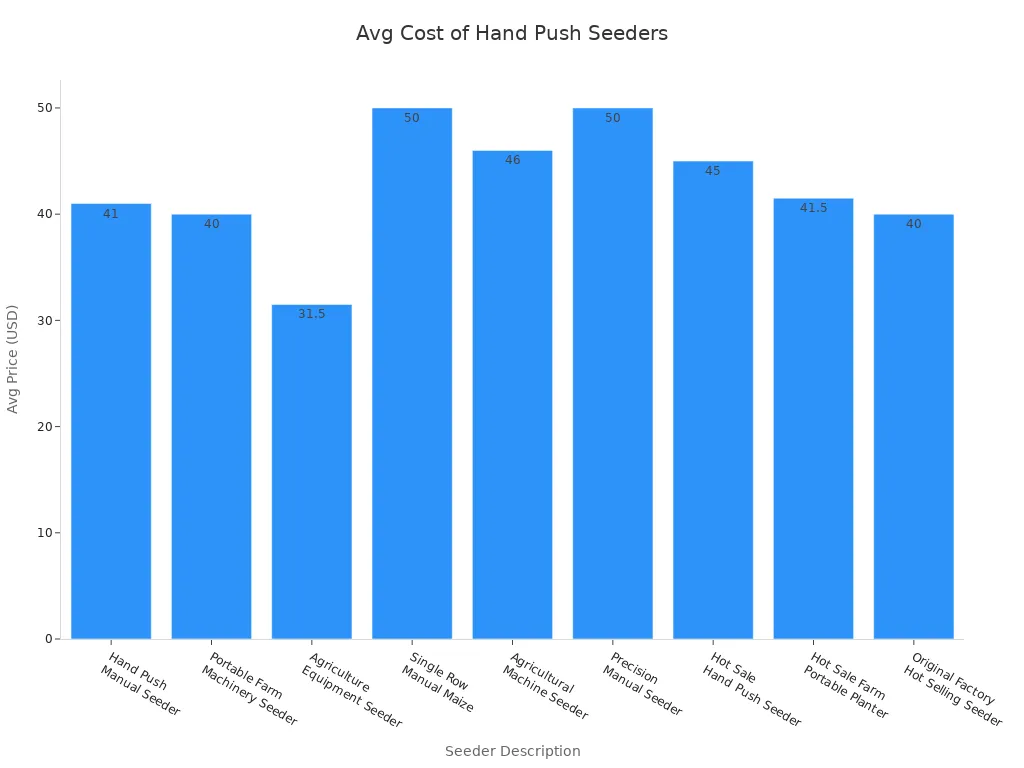
Here is a chart showing the average price range for manual seeder models:
![Bar chart comparing average prices of hand push seeders for small farms]()
Seeder Description | Price Range |
Hand Push Manual Seeder Single and Double Barrel Fully Automatic Small Multi-Function Seeder | $41 |
Portable Farm Machinery Bean Peanut Seeding Planter Manual Push Hand Corn Seeder Machine | $36.50 - $43.50 |
Agriculture Equipment Tools Seeders & Transplanters Hand Manual Push Corn Seeder Planter Machines | $28 - $35 |
Single Row Manual Maize Seeder Corn Planter | $40 - $60 |
Agricultural Machine Seeder Multifunctional Corn Soybean and Peanut Seeder | $39 - $53 |
Precision Manual Seeder Multifunctional Hand Push | $50 |
Hot Sale Hand Push Seeder Seed Planter Machine | $40.50 - $49.50 |
Hot Sale Farm Portable Rice Onion Vegetable Peanut Maize Planter | $38 - $45 |
Original Factory Hot Selling Corn Wheat Soybean Hand Push Seeder Machine | $39 - $41 |
You can find a manual seeder for almost any budget. Precision seeders cost more but often give better planting and more crops. Always balance your money with your field needs and how many rows you want to plant.
Tip: Pick a manual seeder that fits your crops, field size, and budget. This helps you get the best results and makes your farm work better.
Best Garden Seeder Models Compared
Feature Overview
You want to find the best garden seeder for your small farm. You should look at the main features that affect efficiency and performance. The following seeder comparison chart shows what to check when you compare models:
Feature | Description |
Seed Types and Adjustability | Handles many seed sizes and lets you set the depth for better planting. |
Material and Design | Uses strong materials and light weight for easy pushing and long life. |
Ergonomics | Makes planting comfortable and simple, so you can work longer with less effort. |
When you do a comparison of push garden seeders, you see that manual seeders give you precise seed placement. Powered seeders work faster on bigger plots and let you adjust for different seed sizes. The seeder comparison chart below shows how efficiency and seed handling differ:
Seeder Type | Efficiency | Seed Handling |
Manual Seeders | Precise for small gardens | Allows for exact seed placement |
Powered Seeders | Faster for larger plots | Adjustable settings for seed sizes |
Pros and Cons
You need to weigh the pros and cons before you choose. Each type offers different performance and efficiency. Here is a comparison of the main types:
Drop seeders give you accurate planting in small gardens. They may clog and do not work well on slopes.
Drill seeders provide precise depth and spacing. They cost more and need regular care.
Air seeders cover large areas and spread seeds evenly. They are expensive and need skilled users.
Precision planters place each seed with little waste. They work slower and cost more.
Row seeders help you avoid thinning and give high accuracy. They need flat ground and work slower than broadcast types.
Push-type seeders suit larger plots and do not need fuel. They do not fit very large farms unless you use many units.
Walk-behind drills work well for 1–10 acre plots and give moderate precision. They hold less seed and move slower than tractor models.
Note: Efficiency and performance depend on your field size, soil, and crop type. Always do a comparison before you buy.
Model Suitability for Small Farms
You want a model that matches your farm’s needs. The next seeder comparison chart shows which models fit small farms best:
Model | Size Options | Key Features |
Small Ag Series | 4′, 5′, 6′ | Compact, easy to move, micro-meter for small seeds, works well in tight spaces. |
Standard Series | 8′, 10′, 12′ | Versatile, two seed boxes for different seeds, good for many crops. |
Mid-Size Series | Similar to Standard | Larger seed box, better seed spread, efficient for field use. |
You should choose a model that gives you the right balance of efficiency, performance, and value. Small Ag Series models work well for tight plots and specialty crops. Standard and Mid-Size Series models suit bigger gardens and mixed vegetables. Always use a comparison of push garden seeders to match your planting goals.
Choosing the Right Seeder for Your Farm
Matching Seeder to Crop Variety
Choosing the right seeder starts with your crops. Each crop needs a different number of seeds and spacing. You should check if your seeder can handle the seeds you want to plant. For example, carrots and celery need 1–4 seeds per plant and close spacing. Peas need only one seed per spot and more space. The table below helps you match your seeder to your crop variety:
Crop Variety | Seeds per Plant | Plant Spacing (cm) |
Carrots | 1-3 | 5-13 |
Water Spinach | 1-3 | 11-26 |
Celery | 3-4 | 5-13 |
Peas | 1 | 5-26 |
Rapeseed | 1-3 | 2-51 |
Chinese Cabbage | 1-3 | 2-51 |
You get better yields when you use a seeder that fits your crop’s needs. This step helps small-scale farmers avoid waste and makes planting easier.
Aligning Seeder Choice with Planting Goals
Think about your goals before choosing the right seeder. Do you want even rows, less seed waste, or faster planting? A precision seeder helps you plant straight rows and saves seeds. You also get more predictable yields because seeds go in the right place. The table below shows how your goals affect your choice:
Benefit | Description |
Improved Germination | Good seed-to-soil contact and depth help seeds sprout. |
Less Seed Waste | Accurate seed dropping means you use fewer seeds. |
Even and Straight Rows | Uniform stands make thinning and cultivation easier. |
Labor Savings | The right seeder saves you time during planting. |
More Predictable Yields | Consistent seeding rates lead to reliable crop yields. |
Tip: Set your seeder for your main goal. If you want more predictable yields, use a model with depth and spacing controls.
Budget Considerations
You need to balance cost and features when choosing the right seeder. Some seeders cost less but have fewer options. Others cost more but last longer and give better results. The table below shows what you get at each price level:
Budget Tier | Price Range | Features |
Budget Tier | $20–$50 | All-plastic, gravity-fed, limited adjustability |
Mid-Range | $50–$120 | Metal gears, adjustable controls, fits many seed types |
Premium | $120–$200+ | Reinforced frames, modular design, high precision |
You should pick a seeder that matches your budget and planting needs. A mid-range seeder often gives you the best value for predictable yields and better crop yields.
Garden Seeder Buying Guide: Practical Tips
Soil Preparation Steps
You start your planting by preparing the soil. Clean the area by removing stones, weeds, and debris. Loosen the soil with a rake or hoe. This step helps seeds settle and grow strong roots. Make sure the seedbed is smooth and level. A well-prepared seedbed gives you better seed placement and less seed waste. You improve germination and help your crops grow evenly.
Tip: Spend extra time on soil preparation. You get better results and save effort during planting.
Setup and Calibration
You set up your garden seeder by checking the seed plate and hopper. Choose the right plate for your seed type. Adjust the depth and spacing controls to match your crop needs. Fill the hopper with clean, dry seeds. Test the seeder on a small patch to check for even seed distribution. If you see gaps or clumps, adjust the settings. Calibration ensures you plant seeds at the correct depth and spacing. You avoid wasting seeds and get uniform rows.
Use a measuring tape to check row spacing.
Adjust the handle height for comfortable pushing.
Test the seeder before planting the whole field.
Maintenance and Troubleshooting
Regular maintenance keeps your seeder working well. Check all moving parts before and after each use. Clean the seed opener disks and inspect for wear. Look at the closing wheels and row cleaners. Make sure bearings and pivot points move smoothly. Clean the metering units every year and replace damaged parts. Check hoses, nozzles, and tire condition. Update planter monitors if your seeder has digital equipment.
Maintenance Task | Description |
Seed Opener Disks | Set to smallest diameter; check for wear |
Closing Wheels | Inspect for wear; check bearings and pivots |
Row Cleaners | Adjust or replace if worn |
Metering Units | Clean annually; replace damaged parts |
Application Delivery | Check hoses and nozzles for wear |
Tire Condition | Maintain inflation; check for wear |
Planter Monitors | Prepare and update digital equipment |
If you have problems, check the roller mechanism for debris. Operate the seeder on level ground for best results. Water the soil after planting to help seeds settle and sprout.
Note: Good maintenance and troubleshooting help you avoid downtime and keep your seeder efficient.
You can pick the best hand push seeder by following a few simple steps. The table below shows what is most important:
Key Consideration | Description |
Type of seeds | Different seeds need different seeders to plant well. |
Surface to sow | The size of your field helps you choose the right seeder. |
Type of distribution | You can use mechanical, pneumatic, or manual ways to plant seeds. |
Storage capacity | The hopper size changes how much you can plant at one time. |
You should look at different models for your crops and field size. Guides show you the features, prices, and good points of each seeder. Always talk to local farmers for tips and keep your seeder clean and working well for the best results.
FAQ
How do you choose the right seed plate for your crop?
You should match the seed plate to your seed size and shape. Check the manual or chart that comes with your seeder. Test with a small batch to see if seeds drop one at a time.
Can you use a hand push seeder on uneven ground?
You can use most hand push seeders on slightly uneven ground. For very bumpy fields, pick a model with adjustable wheels or flexible frames. This helps keep seed depth even.
How often should you clean your hand push seeder?
You should clean your seeder after every use. Remove leftover seeds and dirt. Wipe down moving parts. Regular cleaning keeps your seeder working well and helps prevent rust.
What should you do if seeds are not dropping evenly?
Tip: Check for clogs in the seed plate or hopper. Adjust the seeder’s settings. Test on a small area before planting the whole field.
Is a hand push seeder worth the investment for a small farm?
A hand push seeder saves you time and reduces seed waste. You get straighter rows and better yields. Most small farms see a quick return on investment, especially if you plant many crops.